What to Eat in Hue: 10 Local Dishes and Where to Find Them

If you are searching for what to eat in Hue, you are in for a treat. As the seat of the Nguyen dynasty from 1802 to 1945, Hue developed a cooking style unlike anywhere else in Vietnam: spicier, more delicate, and built around small, beautifully portioned dishes that once fed an imperial court. Today the same recipes live on in family kitchens, market stalls and tiny shopfronts across the city.
This guide covers the ten dishes worth planning your days around, when to eat them, and a few reliable places to start. If you are still shaping your visit, pair it with our relaxed two-day Hue itinerary so your meals fit neatly between the Citadel and the royal tombs.
What to Eat in Hue: 10 Dishes to Try
1. Bun bo Hue
The city's signature bowl and the reason many food lovers come here. Thick, round rice noodles sit in a beef and pork broth perfumed with lemongrass and fermented shrimp paste, coloured red with annatto and chili oil. Typical toppings include beef shank, pork knuckle and crab-and-pork cake (cha cua), with herbs and banana blossom on the side.
Bun bo Hue is a breakfast dish first. The best stalls start early and many sell out before lunch, so go between about 6 and 9 a.m. If heat is not your thing, ask for it cay (less spicy) and add chili yourself.
2. Com hen (clam rice)
A humble, punchy dish that started on Con Hen, a small islet in the Perfume River. Room-temperature rice is tossed with tiny stir-fried river clams, roasted peanuts, crispy pork crackling, starfruit, herbs and plenty of chili, with a cup of clam broth on the side. Bun hen swaps the rice for noodles.
Con Hen is still the place to try it. Com Hen Hoa Dong, on the islet, is a long-running favourite that several local guides recommend.
3. Banh beo
Tiny steamed rice cakes served in little saucers, each topped with dried shrimp floss, crunchy pork skin and a spoon of sweet fish sauce. You scoop them out one by one with a small spoon. Order a tray and share it.
4. Banh nam and banh bot loc
Two banana-leaf parcels that usually arrive with banh beo. Banh nam is a flat, soft rice-flour cake with minced shrimp and pork; banh bot loc is chewy and translucent, made with tapioca and a whole shrimp inside. Hang Me is a well-known spot for sampler platters of all the Hue rice cakes.
5. Banh khoai
Hue's answer to the crispy pancake: a small, crunchy rice-flour crepe folded around shrimp, pork and bean sprouts, eaten with herbs and a thick dipping sauce made from peanuts, sesame and fermented soybean. Lac Thien at 6 Dinh Tien Hoang Street, near the Citadel, is a popular place to try it.
6. Nem lui
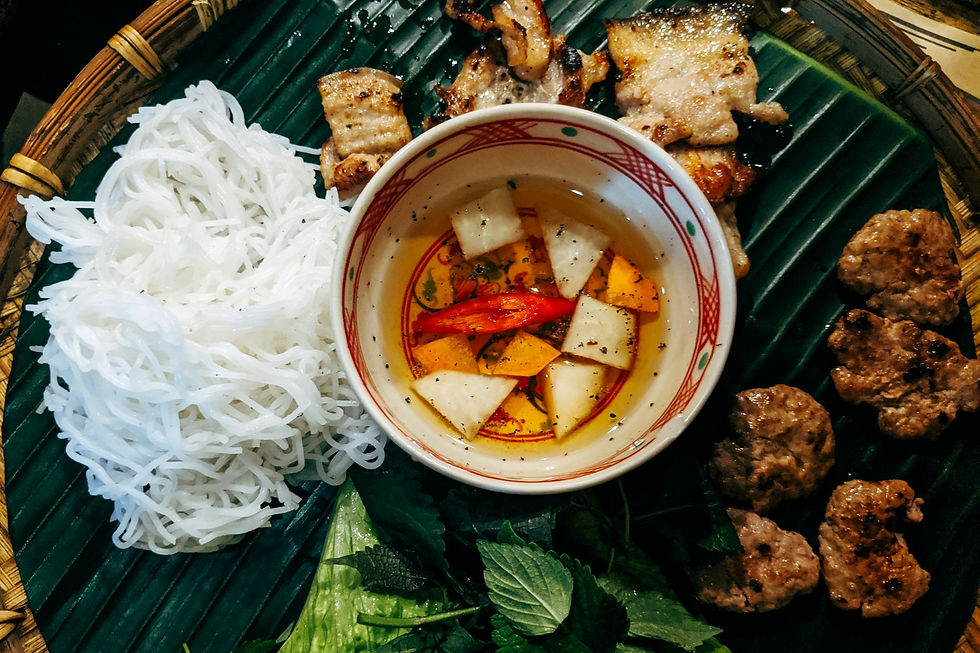
Minced pork wrapped around lemongrass stalks and grilled over charcoal. You slide the meat off, roll it in rice paper with herbs, green banana and starfruit, then dip it in peanut sauce. It is a fun, hands-on dish, and a great choice for kids or anyone wary of spice.
7. Banh ep
A cheap and cheerful evening snack: tapioca dough pressed flat and toasted, topped with egg, pork or quail egg and served with chili fish sauce. Nguyen Du Street becomes a small banh ep strip in the evening, with plastic stools and plenty of locals.
8. Banh canh
A comforting soup with thick, slippery noodles made from rice and tapioca flour. In Hue you will often see banh canh Nam Pho, named after a village just outside the city, with a crab and shrimp broth that is slightly sticky and very satisfying on a rainy day.
9. Che (sweet soups)
Hue is famous for its many kinds of che, from sweet corn and lotus seed to mung bean and tapioca pearls, served warm or over crushed ice. Che Hem, tucked in an alley off Hung Vuong Street, offers a long menu, so it is easy to try three or four in one sitting.
10. Ca phe muoi (salt coffee)
Vietnamese coffee topped with a lightly salted cream foam. It sounds odd and tastes brilliant: the salt softens the bitterness and makes the cream taste richer. Salt coffee was popularised in Hue and is now served all over the city.
How to Plan a Day of Eating in Hue
Hue's food rhythm follows the clock, and timing makes a big difference to what you can find.
Early morning (6 to 9 a.m.): bun bo Hue, while the broth is fresh and the best stalls are still open.
Late morning: Dong Ba Market, the city's biggest market on the north bank of the Perfume River, where food stalls let you sample several snacks in one stop.
Lunch: com hen on Con Hen islet, or a tray of banh beo, banh nam and banh bot loc.
Afternoon: salt coffee or a bowl of che to cool down after sightseeing.
Evening: banh ep on Nguyen Du Street, or banh khoai and nem lui at a sit-down restaurant.
Where to Try Many Dishes at Once
Short on time? A few restaurants serve set menus that cover most Hue classics in one meal. Hanh Restaurant at 11 Pho Duc Chinh is a small, family-run favourite with an English menu, and a tasting set there is a painless way to try banh beo, banh khoai and nem lui side by side.
For something more formal, several garden-house restaurants recreate imperial court cuisine with multi-course set menus, elaborate presentation and sometimes traditional music. It is pricier than street food and more about the experience than the flavour, but it suits a special dinner or a family celebration.
One honest note: small Hue eateries change their hours, and sometimes their location, without much warning. Check a recent map review before making a special trip.
Practical Tips for Eating in Hue
Go early for noodle soups. A quiet shop at 1 p.m. may simply have run out.
Learn two phrases: it cay (less spicy) and khong cay (not spicy).
Con Hen and the Vy Da area are a short Grab ride from the centre and worth the detour for clam dishes.
Carry small notes. Street stalls rarely take cards.
Hue's rainy season usually runs from about September to December. Soups and banh canh are perfect then, but bring an umbrella for walking between stalls.
Heading south after Hue? The drive over the Hai Van Pass brings you to a completely different food culture, so keep room for our guide on what to eat in Hoi An.
FAQ: Food in Hue
Is Hue food really spicy?
Spicier than most Vietnamese food, yes, but you are rarely stuck with it. Chili usually comes as oil or fresh slices you add yourself, and many vendors will make a milder bowl if you ask for it cay.
What is the difference between bun bo Hue and pho?
Pho uses flat rice noodles in a clear, gently spiced beef broth. Bun bo Hue uses thick, round noodles in a bolder broth with lemongrass, shrimp paste and chili, and often includes pork as well as beef.
Is imperial cuisine worth trying?
If you enjoy food as theatre, yes. For pure flavour, most visitors find the city's everyday dishes, from bun bo Hue to banh khoai, just as memorable and far cheaper. Ideally, try one imperial-style dinner and spend the rest of your meals on the street.

Comments